


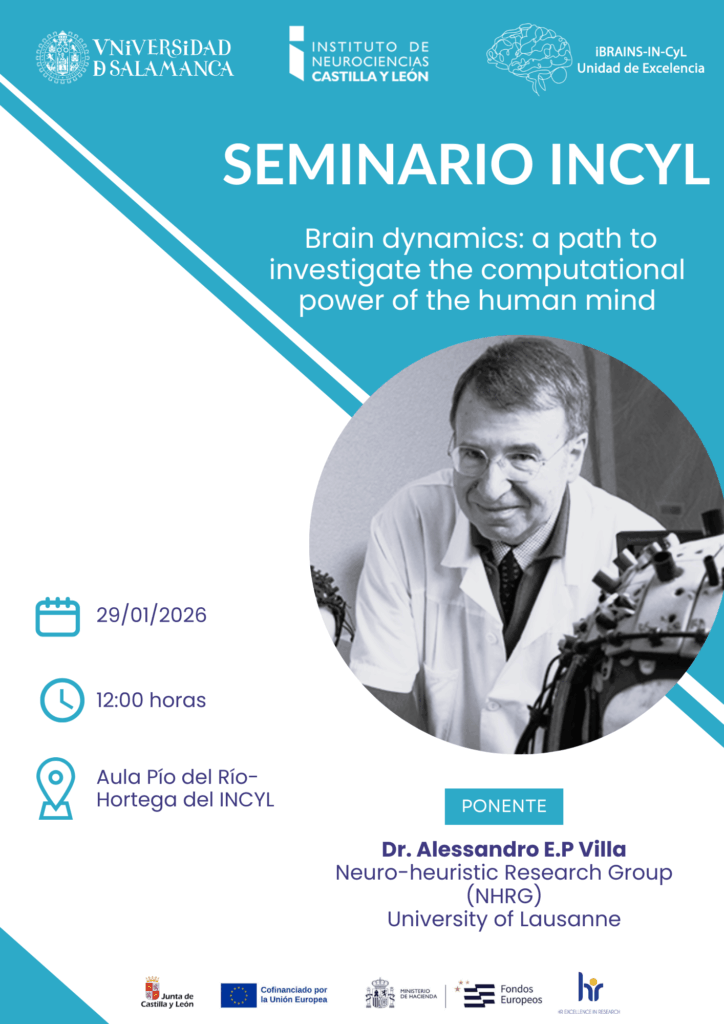
The human mind is characterized by an extraordinary capacity for processing, adaptation, and flexibility, whose ultimate substrate lies in the dynamics of the brain. In this talk, I will address how the study of brain dynamics provides a privileged avenue for investigating the computational power of the human brain. Within a conceptual framework that views the brain as a complex dynamical system, I will examine how temporal patterns of neuronal activity—beyond static or averaged descriptions—offer access to the fundamental mechanisms underlying perception, cognition, and behavior. I will present recent results obtained using functional neuroimaging techniques with high temporal resolution, with particular emphasis on approaches that allow the characterization of the dynamic evolution of distributed neural networks across different experimental contexts. Through examples drawn from sensory and cognitive paradigms, I will discuss how these dynamics reflect processes of encoding, integration, and prediction, and how their modulation or alteration can provide relevant insights at both the basic level and in clinical populations. Finally, I will discuss the implications of this approach for a deeper understanding of brain computation, as well as its potential impact on cognitive neuroscience, neuroengineering, and translational medicine.
«La mente humana se caracteriza por una extraordinaria capacidad de procesamiento, adaptación y flexibilidad, cuyo sustrato último reside en la dinámica del cerebro. En esta charla abordaré cómo el estudio de las dinámicas cerebrales constituye una vía privilegiada para investigar el poder computacional del cerebro humano. Desde un marco conceptual que entiende el cerebro como un sistema dinámico complejo, analizaré cómo los patrones temporales de la actividad neuronal —más allá de descripciones promedio o estáticas— permiten acceder a los mecanismos fundamentales que sustentan la percepción, la cognición y el comportamiento. Se presentarán resultados recientes obtenidos mediante técnicas de neuroimagen funcional con alta resolución temporal, con especial atención a enfoques que permiten caracterizar la evolución dinámica de redes neuronales distribuidas en distintos contextos experimentales. A través de ejemplos procedentes de paradigmas sensoriales y cognitivos, se discutirá cómo estas dinámicas reflejan procesos de codificación, integración y predicción, y cómo su modulación o alteración puede aportar información relevante tanto a nivel básico como en poblaciones clínicas. Finalmente, se debatirán las implicaciones de este enfoque para una comprensión más profunda de la computación cerebral, así como sus proyecciones en neurociencia cognitiva, neuroingeniería y medicina traslacional.»
Related studies:
- Villa, A.E.P. Redefining cognitive neurodynamics through transdisciplinary innovation. Cogn Neurodyn 19: 144. (2025). https://doi.org/10.1007/s11571-025-10332-z
- Lintas, A., Knight, R. S., & Villa, A. E. P. (2025). Neuroimaging fairness in economic decisions: EEG and EROS analysis in the Ultimatum Game. Brainiacs Journal, 6(1): UD194FE74. https://doi.org/10.48085/UD194FE74
- Jaquerod, M. E., Knight, R. S., Lintas, A., & Villa, A. E. P. (2024). A dual role for the dorsolateral prefrontal cortex (DLPFC) in auditory deviance detection. Brain Sciences, 14(10): 994. https://doi.org/10.3390/brainsci14100994
- Abe, T., Asai, Y., Lintas, A., & Villa, A. E. P. (2024). Detection of quadratic phase coupling by cross-bicoherence and spectral Granger causality in bifrequency interactions. Scientific Reports, 14: 8521. https://doi.org/10.1038/s41598-024-59004-8
- Malagarriga, D., Pons, A. J., & Villa, A. E. P. (2019). Complex temporal pattern processing by a neural mass model of a cortical column. Cogn Neurodyn 13: 379. https://doi.org/10.1007/s11571-019-09531-2
- Cabessa, J., & Villa, A. E. P. (2018). Attractor dynamics of a Boolean model of a brain circuit controlled by multiple parameters. Chaos, 28, 106318. https://doi.org/10.1007/10.1063/1.5042312
- Masulli, P., & Villa, A. E. P. (2016). The topology of the directed clique complex as a network invariant. SpringerPlus, 5: 388. https://doi.org/10.1186/s40064-016-2022-y
- Villa, A. E. P., & Iglesias, J. (2010). Recurrent spatiotemporal firing patterns in large spiking neural networks with ontogenetic and epigenetic processes. Journal of Physiology – Paris, 104: 137. https://doi.org/10.1016/j.jphysparis.2009.11.016