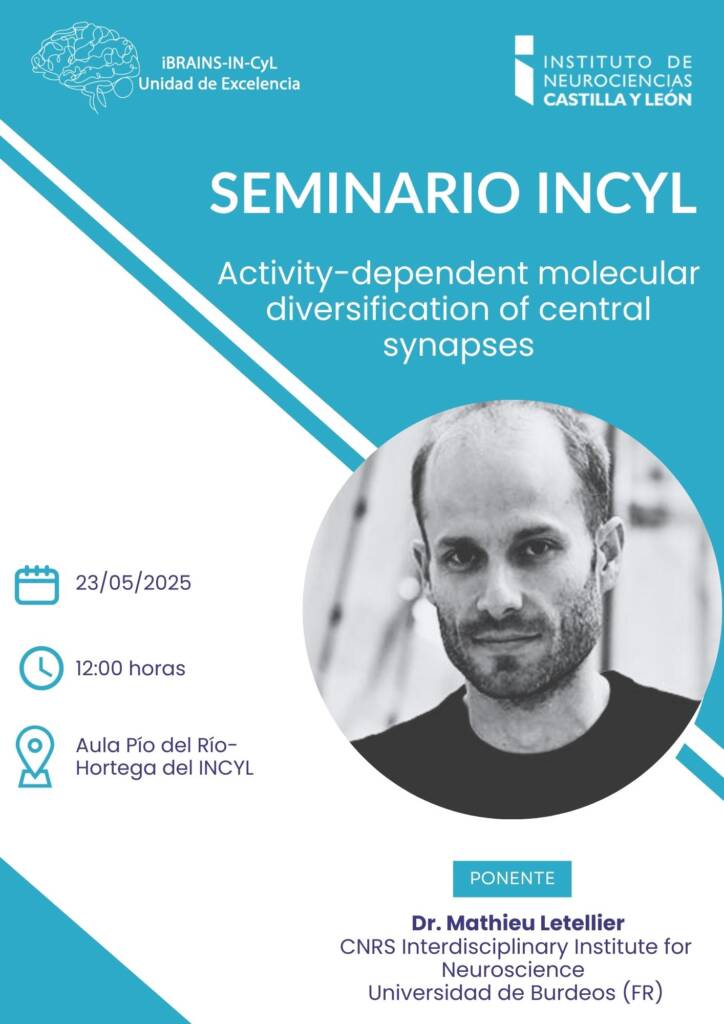


Abstract: The ability of the brain to constantly adapt its organization to ever-changing stimuli is termed ‘plasticity’ and is a prominent feature not only of learning and memory in the adult, but also of neuronal circuit assembly during developmental critical periods. Connections that are the most active become stronger and more stable, while the less active ones weaken and eventually get eliminated. How does activity make specific synapses stronger or weaker and how does it serve synaptic circuit refinement? In both immature and mature circuits, long-term changes in synapse function and organization involves signaling which regulate the traffic of synaptic proteins including cell adhesion molecules, scaffolding proteins and receptors, but also requires the expression of specific genes through transcription and translation dependent mechanisms. In this seminar, I will begin by presenting how activity-dependent local translation of synaptopodin—a protein associated with the spine apparatus—serves as a molecular tag for hippocampal synapses and contributes to their specific plasticity properties. I will then present current work in which we investigate how specific connections get molecularly encoded in the developing cerebellum by implementing the patch-seq technique.
Publications:
miR-124-dependent tagging of synapses by synaptopodin enables input-specific homeostatic plasticity.
Dubes S, Soula A, Benquet S, Tessier B, Poujol C, Favereaux A, Thoumine O, Letellier M. EMBO J. 2022 Oct 17;41(20):e109012. doi: 10.15252/embj.2021109012. Epub 2022 Jul 25. PMID: 35875872 Free PMC article.
Differential role of pre- and postsynaptic neurons in the activity-dependent control of synaptic strengths across dendrites.
Letellier M, Levet F, Thoumine O, Goda Y. PLoS Biol. 2019 Jun 5;17(6):e2006223. doi: 10.1371/journal.pbio.2006223. eCollection 2019 Jun.
Synapse elimination in olivo-cerebellar explants occurs during a critical period and leaves an indelible trace in Purkinje cells.
Letellier M, Wehrlé R, Mariani J, Lohof AM. Proc Natl Acad Sci U S A. 2009 Aug 18;106(33):14102-7. doi: 10.1073/pnas.0902820106. Epub 2009 Aug 3.