


Information for researchers
Service portfolio.
Storage and custody
Recruitment, processing and custody
Surplus samples
Transfer of samples
Request for samples.
The BTN-INCYL has a procedure for requesting the transfer of nervous tissue samples through the IBSAL Biobanks Platform. On the IBSAL website, the researcher will select the most appropriate option for the required service, in this case, the request for samples for research projects.
1st – The requesting researcher must complete and sign the Sample Request Form for research projects, available on the IBSAL website, and send it to two email addresses: secretaria@ibsal.es and btn-incyl@usal.es. In this document, the requesting researcher must specify the samples requested, the selection criteria, and the associated data required. In addition, they must provide a summary of the research project in which the samples/data will be used, including at least the project objectives and the parameters to be analysed across the sample set, the expected impact of the project on national and international research, and the ethical aspects involved in the use of the requested samples/data.
2nd – In addition to the information included in this form, the principal investigator must attach to the application: a) the favourable opinion of the ethics committee that approved the research project in which the samples/data will be used; b) documentation proving the project’s funding; and c) a copy of the research project.
3rd – The sample/data request will be submitted, for review and approval if appropriate, to the external Ethics and Scientific Committees to which the BTN-INCYL is affiliated.
4th – Once favourable reports have been received from both Committees, a Material Transfer and Sample Transfer Agreement (MTA) for biological samples (and associated clinical data) for research purposes will be signed. This agreement will be signed by the requesting researcher and countersigned by the representative of the institution where they are employed.
5th – By signing the Sample Request and the MTA, the principal investigator undertakes to:
• Use the material provided by the IBSAL Biobanks Platform under the biosafety conditions established by current legislation, particularly with regard to its transport, and to ensure the destruction of surplus material and waste that has been in direct contact with the samples.
• No realizar cesiones de las muestras o datos asociados a las mismas a terceros, fuera del grupo de investigación que apoya la solicitud.
• Not use the obtained samples for purposes other than those stated in the application; to return to the BTN-INCYL and/or destroy any remaining samples once the project for which they were granted has been completed; and to report any possible incident that may have interfered with the use of the samples for the intended purposes and within the planned timeframe.
• Provide detailed information on the parameters to be analysed across the sample set.
• Ensure traceability of the samples and guarantee to the IBSAL Biobanks Platform the availability of any information obtained, where applicable, from their analysis.
• Make the results of the research available to other researchers if they have not been published within a period not exceeding two years after the completion of the project, and to retain and safeguard those results for a minimum period of five years after the project’s completion.
• Acknowledge the origin of the samples (IBSAL Biobanks Platform, Neurological Tissue Bank of the Institute of Neurosciences of Castile and León) in all publications in which results obtained from research using samples from the IBSAL Biobanks Platform are disseminated. This acknowledgment must be included in the “Materials and Methods” section and/or in the “Acknowledgements” section.
• Send a copy of any scientific articles published as a result of the study for which the samples were provided, as well as, within two years, a report on the research conducted.
• Ensure compliance with the ethical requirements associated with the handling of human samples in research.
Fees
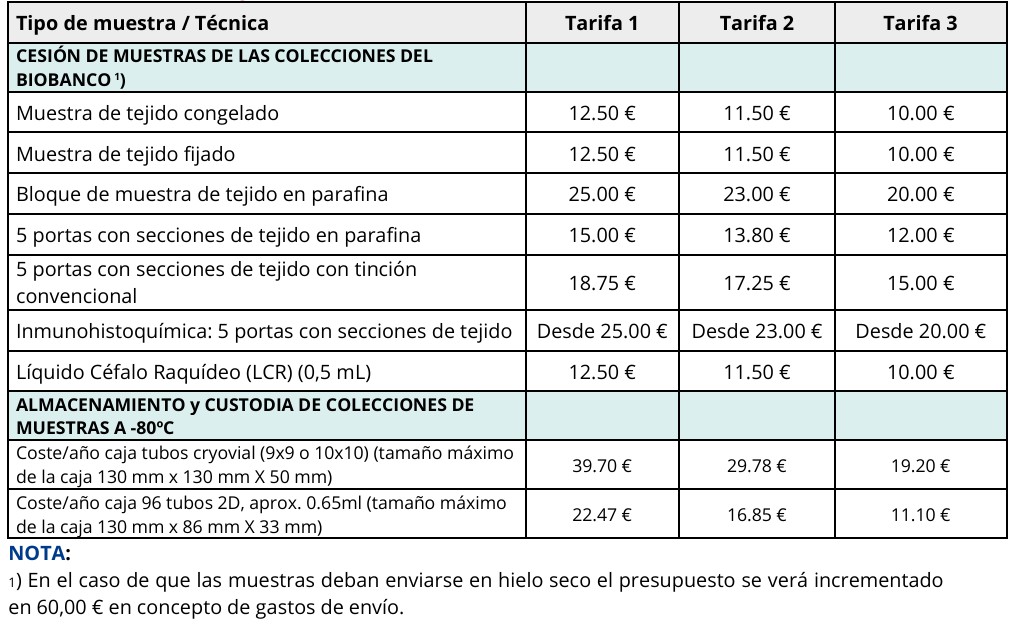
The samples available through the IBSAL Biobanks Platform are exempt from any commercial value. However, the requesting group must cover the costs of handling, maintenance, and transport of the provided samples. Likewise, the costs for the remaining services offered correspond solely to processing, shipping, and application management expenses.
Billing to researchers requesting biological samples may reflect reductions linked to the total number of samples supplied for the study, or increases related to specific preparation difficulties required for certain analytical work. Three different types of fees (VAT not included) have been established and are reviewed annually:
Fee 1: General.
Fee 2: Non-profit national research centres.
Fee 3: Internal users (IBSAL, SACyL, USAL, and joint USAL/CSIC institutes
Sample collection.
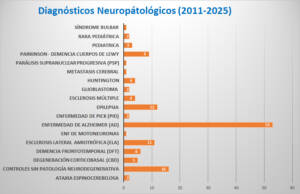
The total number of brains available in our biobank is 135, and this chart provides a general overview of the number of brains according to the neuropathological diagnosis performed.
(*) Both the number and the chart are updated at the end of each year
Sample Transfer
The BTN-INCYL has provided various types of nervous tissue samples to researchers worldwide who requested them and complied with the strict ethical, legal, and scientific requirements established by current legislation.
Some of the research projects, scientific publications, and communications to conferences and symposia in which samples from our biobank were used are listed below:
Research Projects:
- 2025.- “Genomics and digital neuropathological phenotyping of iberian brains (GADIR)”. IP: Alberto Rábano Gutiérrez, Banco de Tejidos Neurológicos de la Fundación CIEN, Madrid.
- 2024.- “Estudio de nuevas aplicaciones y avances del péptido inhibidor de SRC, TAT-CX43, en la terapia contra tumores cerebrales”. IP: María Aránzazu Tabernero Urbieta, Dpto. Bioquímica y Biología Molecular, Universidad de Salamanca, Instituto de Neurociencias de Castilla y León (INCYL).
- 2024.- “Capacidad metabólica y caracterización celular del hipocampo en la enfermedad de Alzheimer y en un modelo animal de degeneración neuronal por aluminio”. IP: Manuel Garrrosa García, Facultad de Medicina de la Universidad de Valladolid, Instituto de Neurociencias de Castilla y León (INCYL).
- 2023.- “Evaluación de diferentes productos de PCR a tiempo real relacionados con la detección de patógenos implicados en procesos de meningitis en LCR”. IP: Henar Alonso Ezcurra.
- 2023.- “Investigating GPR55 as a novel neuroprotective target in experimental Parkinson’s disease”. IP: José Javier Fernández Ruíz. Dpto. Bioquímica y Biología Molecular. Facultad de Medicina. Universidad Complutense de Madrid.
- 2022.- “El sistema purinérgico como diana terapeútica para el tratamiento de la ataxia espinocerebelosa tipo 3 / enfermedad de Machado-Joseph”. IP: Felipe Ortega de la O. Dpto. Bioquímica y Biología Molecular. Facultad de Veterinaria. Universidad Complutense de Madrid.
- 2021.- “Searching for new molecular biomarkers for the detection of epileptogenesis”. IP: Dolores E. López. Instituto de Neurociencias de Castilla y León (INCYL) – Universidad de Salamanca.
- 2016.- “Validación de un modelo de cultivo epitelio pigmentario humano para el estudio de la DMAE y el ensayo de terapias farmacológicas.” IP: Mª Concepción Lillo Delgado. Instituto de Neurociencias de Castilla y León (INCYL) – Universidad de Salamanca.
- 2015.- “Bases genéticas-moleculares de las ataxias espinocerebelosas: identificación del defecto molecular causativo de la ataxia espinocerebelosa tipo 37 (SCA37).” IP: Antoni Matilla Dueñas. Instituto de Investigación Germans Trias y Pujol (IGTP). Badalona (Barcelona).
- 2013.- “Estudio funcional del polimorfismo rs2229094 del gen linfotoxina Alpha. Proyecto Retina 4.” IP: Salvador Pastor Idoate. Instituto Oftalmobiología Aplicada (IOVA) -Universidad de Valladolid.
- 2011.- “Alteraciones del tráfico intracelular en la enfermedad de Parkinson”. IP: Mónica Tomás Caballero. Dpto. Anatomía y Embriología Humana de la Facultad de Medicina de la Universidad de Valencia.
Articles, theses, Master’s theses (TFMs), and conference communications:
- Doctoral Theses: Santiago Rodríguez Carreiro. Exploring new targets for developing cannabinoid-based therapies in Parkinson’s disease. Directores: José Javier Fernández Ruiz y Elisa Navarro González de Mesa. 15 de septiembre de 2025
- Sánchez-Flores M, Corral-Juan M, Gasch Navalón E, Cirillo D, Sánchez I, Matilla-Dueñas A. Novel genotype-phenotype correlations, differential cerebellar allele-specific methylation, and a common origin of the Iberian (ATTTC)n insertion in spinocerebellar ataxia type 37. Human Genetics, 143(3):211-232 [PMID: 38396267; DOI: 10.1007/s00439-024-02644-7] (2024).
- TFM Máster en Genética Avanzada, Universitat Autònoma de Barcelona: “Molecular physiopahology study of VPS13D-ataxia in a Spanish patient”. Gabriela Chabrzyk. 2024.
- TFM Máster en Biotecnología Molecular, Universidad de Barcelona: “Identification of potential biomarkers of disease progression in Friedreich’s Ataxia”. Nicolás Llanes Vizcaíno, 2024.
- Martins S, Yahia A, P. D. Costa I, E. Siddig H, Abubaker R, Koko M, Corral-Juan M, Matilla-Dueñas A, Brice A, Durr A, Leguern E, P. W. Ranum L, Amorim A, E.O. Elsayed L, Stevanin G, Sequeiros J. Machado-Joseph disease in a Sudanese family links West Africa to Portuguese families and allows reestimation of ancestral age of the Machado lineage. Human Genetics, Dec;142(12):1747-1754 [PMID: 37957369] (2023).
- TFM Máster en Genética Avanzada, Universitat Autònoma de Barcelona: “Characterization of the biodistribution of recombinant frataxin protein in the Friedreich ataxia mouse model treated with AAV-FXN gene therapy”. José Cánovas Marín, 2023.
- TFM Máster en Investigación Biomédica, Universidad Pompeu Fabra: “Undiagnosed inherited ataxias: identification of a novel spinocerebellar ataxia subtype”. Nerea Ramírez Martínez, 2023.
- TFM Máster Universitario en Neurociencias. Universidad de Salamanca. “Expresión de genes de la vía mTOR en neuronas con alteraciones patológicas de pacientes con epilepsia refractaria”. Tutor: Javier Herrero-Turrión. Alumna: Alejandra Macías Cerro. 18 de julio de 2023.
- Corral-Juan M, Casquero P, Giraldo N, Laurie S, Martinez-Piñeiro A, Mateo RC, Ispierto L, Vilas D, Tolosa E, Volpini V, Alvarez-Ramo R, Sanchez I, Matilla-Dueñas A. New spinocerebellar ataxia caused by SAMD9L mutation triggering mitochondrial dysregulation (SCA49). Brain communications 4 (2), fcac030 [PMID: 35310830] (2022). Editor’s Choice.
- Matilla-Dueñas A., Infante J., Serrano-Munuera C., Ivánovic-Barbeito Y., Alvarez R., Sánchez I. (2022) Novel Therapeutic Challenges in Cerebellar Diseases pp.2667-2699. In: Manto M.U., Gruol D.L., Schmahmann J.D., Koibuchi N., Sillitoe R.V. (eds) Handbook of the Cerebellum and Cerebellar Disorders. Springer, Cham. https://doi.org/10.1007/978-3-030-23810-0_106
- TFM Máster en Genética y Genómica, Universidad de Barcelona: “Targeted nanopore sequencing of the SCA37 (ATTTC)n expanded insertion within the DAB1 gene proves a common origin and differential methylation”. Marina Sánchez Flores, 2022.
- TFM Máster en Genética Avançada, Universidad Autònoma de Barcelona: “A new CRISPR-Cas9 target sequence enrichment for the analysis of the expanded region in FXN, its methylation profile and expression”. Natalia Benítez Calle, 2022.
- Comunicación escrita (póster): Herrero-Turrión MJ, Castellano O, Gómez-Nieto R, Sanabria A, Lara JC, García-Peral C, Chinchilla-Tábora LM, Alberdi, MP, Ludeña MD, Malmierca MS, López DE. Colaboración científica del BTN-INCYL en el abordaje multidisciplinar de las alteraciones cerebrales subyacentes a la epilepsia. I Jornadas de Biobancos y Biomodelos. Santander, 27 y 28 de octubre de 2022.
- Tomás M, Martínez-Alonso E, Martínez-Martínez N, Cara-Esteban M, Martínez-Menárguez JA. Fragmentation of the Golgi complex of dopaminergic neurons in human substantia nigra: New cytopathological findings in Parkinson’s disease. Histol Histopathol. 2021 Jan;36(1):47-60. doi: 10.14670/HH-18-270.
Manrique L, Sánchez-Rodríguez A, Pelayo-Negro AL, Corral-Juan M, Matilla- Dueñas A, Infante J. Ataxia and action myoclonus related to novel mutations in ATP13A2 gen. Movement Disorders Clinical Practice 8(6), 969-971 [PMID: 34405108] (2021).
- TFM Máster en Genética y Genómica, Universidad de Barcelona: “Analysis of the wild-type and SCA37 repeat alleles of the DAB1 gene by nanopore sequencing”. Esther Gasch Navalón, 2021.
- Comunicación escrita (póster): Herrero Turrión, M.J.; Blázquez Hidalgo, E.; Sánchez Sánchez, J.; Ruiz Ayúcar, I.; Hernández Fabian, A.; Marcos Vadillo, E.; García Berrocal, B.; Isidoro García, M.; Prieto Matos, P.; Rábano Gutiérrez, A. Colaboración científica del BTN-INCYL en el diagnóstico y un mayor conocimiento de las enfermedades raras pediátricas. X Congreso Nacional de Biobancos. Valencia, 17 al 18 de octubre de 2019.
- Comunicación escrita (póster): López Mongil, R.; Torres Nieto, A.; Herrero Turrión, M.J.; Rábano Gutierrez, A.; Izquierdo Delgado, E.; López Trigo, J.A. Donación de cerebro: decisión extraordinaria en geriatría. 61º Congreso Sociedad Española de Geriatría y Gerontología. Zaragoza, 12 al 14 de junio de 2019.
- Corral-Juan M, Serrano-Munuera C, Rábano A, Cota-González D, Segarra-Roca A, Ispierto L, Cano-Orgaz AT, Adarmes AD, Méndez-Del-Barrio C, Jesús S, Mir P, Volpini V, Alvarez-Ramo R, Sánchez I, Matilla-Dueñas A. Clinical, genetic and neuropathological characterization of spinocerebellar ataxia type 37. Brain. 2018 Jul 1;141(7):1981-1997. doi: 0.1093/brain/awy137. PMID: 29939198.
- Tesis doctoral: Caracterización de la expresión, localización y funciones de la proteína de polaridad celular CRB2 en cerebro murino y humano. Autor: Jorge Fernández Dolón. Fecha de defensa:28/09/2018.
- Pastor-Idoate S, Rodríguez-Hernández I, Rojas J, Gonzalez-Buendia L, Delgado-Tirado S, López JC, González-Sarmiento R, Pastor JC. Functional characterization of rs2229094 (T>C) polymorphism in the tumor necrosis factor locus and lymphotoxin alpha expression in human retina: the Retina 4 project. Clin Ophthalmol. 2017 May 22; 11:973-981. doi:10.2147/OPTH.S135170. eCollection 2017. PMID: 285797485